What does the painting exhibit beyond the scene of the last supper? It seems like an ordinary painting only depicting a scene from the bible, but it is much more than that. Certain religious themes of the late 15th century are exhibited by the painting by Leonardo Da Vinci, The Last Supper. It displays the theme of Christianity and the concept of heaven. In addition, the sources are credible as the Italian renaissance is a non-profit organization, with various sources. Along with, the credible video by Dr. Beth Harris and Dr. Steven Zucker on Khan Academy as it is an educational non-profit organization, as well as the narrators, are respectable professionals in the field of Art History.
_-_WGA12732.jpg) |
The articles by Italian Renaissance and by Dr. Beth Harris and Dr. Steven Zucker on Khan Academy reveal interpretations on the theme of the painting. Leonardo Da Vinci displays the scene from the Gospels account on the night before Christ’s Death. The scene displays the twelve disciples, along with Jesus in a rectangular room. The room has coffers on the ceiling, along with tapestries on either side of the wall. At the back of the room, there are three windows, through which beautiful landscape can be viewed. The apostles are seated in four groups of three, with Christ in the center. We witness the moment after Christ makes a revelation that one of his disciples will betray him. We can observe in the painting when, “ Christ says to his apostles ‘One of you will betray me,’ and the apostles react, each according to his own personality” (Dr.Beth Harris and Dr.Steven Zucker). Furthermore, we see Judas, “however, (he) is shadowed, so that we only see part of his face while he clutches the money bag containing silver pieces” (Dr.Beth Harris and Dr.Steven Zucker). Moreover, at the same time, we can see Judas, backing away defensively, and Christ reaching for the same plate that lies between them. In addition, another important scene is concurring, depicting “Christ blessing the bread and saying to the apostles ‘Take, eat; this is my body’ and blessing the wine and saying ‘Drink from it all of you; for this is my blood of the covenant, which is poured out for the forgiveness of sins’ (Matthew 26)” (Dr.Beth Harris and Dr. Steven Zucker).
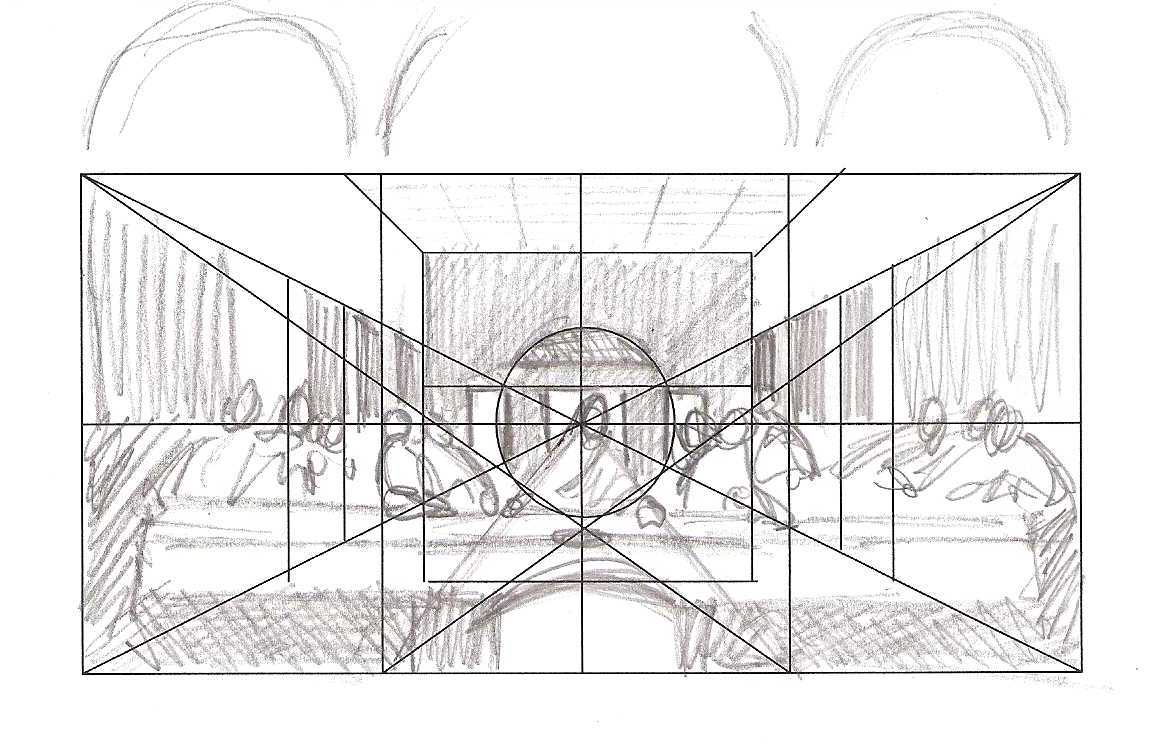 |
The interpretation given by the authors in both Italian Renaissance and Khan Academy suggest the same scenario and depiction. Leonardo depicts the twelve apostles are arranged in four groups of three, along with three windows. One can interpret that, “The number three is often a reference to the Holy Trinity in Catholic art” (Dr. Beth Harris and Dr. Steven Zucker). The symbolism of the Holy Trinity reminds the believers of Christianity, a majority of the high renaissance that there is only one god. In contrast, Leonardo was not a religious person and “the number four is important in the classical tradition (e.g. Plato’s four virtues)” (Dr.Beth Harris and Dr. Steven Zucker). Nevertheless, Christianity is the main portrayal of the painting. Furthermore, the landscape beyond the window is often interpreted as paradise, “ it has been suggested that this heavenly sanctuary can only be reached through Christ” (Dr. Beth Harris and Dr. Steven Zucker). This is another, important idea that supports the concept of heaven. The belief that the disbelievers of God will lead to a judgment to hell, while believers of God a judgment to heaven is portrayed. Furthermore, Leonardo depicts the heavenly perfection of Jesus through geometry, which the Greeks believed to symbolize perfection. One can see from the picture on the left that “the balanced composition is anchored by an equilateral triangle formed by Christ’s body. He sits below an arching pediment that if completed, traces a circle. These ideal geometric forms refer to the renaissance interest in Neo-Platonism (an element of the humanist revival that reconciles aspects of Greek philosophy with Christian theology)” (Dr. Beth Harris and Dr. Steven Zucker). Once again, the importance and admiration for Jesus in Christianity of the high renaissance is depicted.
FUTURE RESEARCH QUESTION: What do the visual arts of the high renaissance depict about the culture of society?

No comments:
Post a Comment